
Endurance Church · 2026-09-13
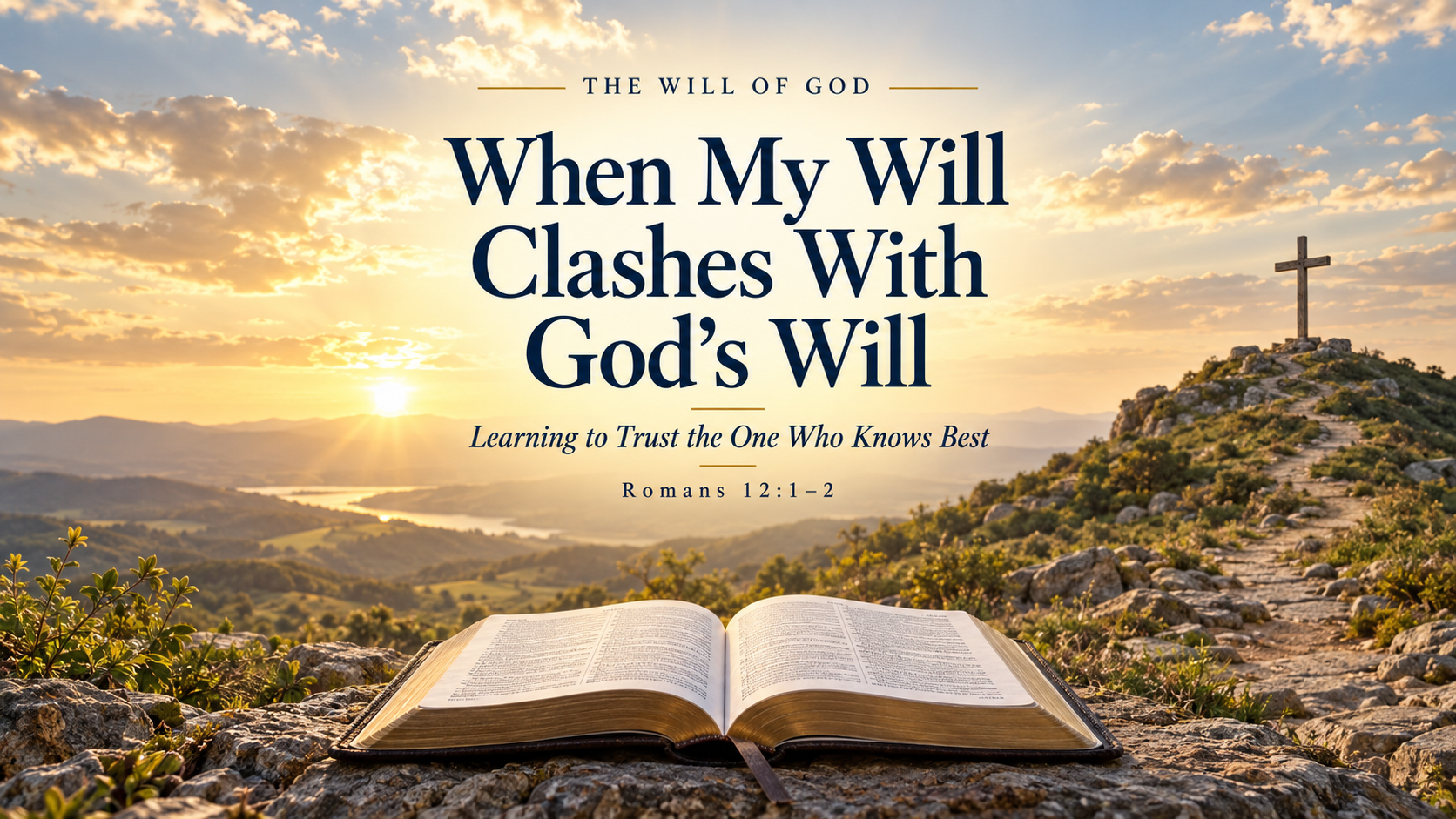
When My Will Clashes With God’s Will: Learning to Trust the One Who Knows Best
What happens when our desires clash with God’s Word? Explore how trusting His goodness and allowing Him to renew our minds helps us surrender our will and walk in His.
Have you ever been absolutely convinced you were right—only to discover later that you were painfully wrong?
You trusted what you saw.
You followed what you felt.
You made the decision that seemed best at the time.
But when the consequences showed up, what looked right wasn’t right, what felt like freedom became bondage, and what promised life ended in pain.
That is the quiet, terrifying power of deception.
A deceived person doesn’t know they’re deceived. They don’t think they’re rejecting the truth—they believe they’ve discovered a better version of it. They’re not trying to walk toward destruction; they honestly believe they’ve finally found the path to freedom.
Scripture tells us this struggle didn’t begin with us. It began in a garden.
The First Question: “Can You Really Trust God’s Will?”
Adam and Eve lived in a world untouched by pain, shame, fear, or death. Their identity, purpose, provision, and fellowship all came directly from God. Everything around them testified to His goodness.
Then the serpent entered with one devastating question:
“Has God indeed said…?” (Genesis 3:1)
Underneath that question was another:
“Can you really trust God’s will?”
The serpent twisted God’s command into something it was never meant to be. Instead of protection, it sounded like restriction. Instead of love, it sounded like control. The lie was simple but deadly:
- “God is holding something back from you.”
- “Life could be better if you stepped outside His will.”
- “You’ll be more if you take control of your own life.”
Eve looked at the tree and saw three things (Genesis 3:6):
- It was good for food – lust of the flesh
- It was pleasant to the eyes – lust of the eyes
- It was desirable to make one wise – pride of life
These are the same three temptations we fall to today. We can’t look down on Eve; we repeat the same pattern every time we choose our will over God’s.
And when Adam and Eve ate, their eyes were opened—not to more of God, but to the shame of their own nakedness. Contrast that with the disciples on the road to Emmaus; when Jesus broke bread, their eyes were opened to who He was.
The fall opened humanity’s eyes to self; the gospel opens our eyes to Christ.
The Battle Beneath Every Sin: Do I Trust God’s Goodness?
After the fall, deception became woven into the very fabric of our fallen world. We are born into a culture that disciples us to:
- Trust ourselves
- Follow our hearts
- Define our own truth
- Build our lives around our own desires
Scripture puts it plainly:
“The god of this age has blinded the minds of unbelievers…” (2 Corinthians 4:4)
Satan doesn’t just lie to us from the outside; his lies often sound like our own thoughts.
Before he pushes us toward disobeying God’s will, he first attacks God’s goodness:
- “God’s commands are too restrictive.”
- “He doesn’t really get what you’re going through.”
- “If you obey, you’ll miss out.”
If we begin to suspect that God is withholding something good from us, disobedience starts to look like liberation. We rename sin:
- Disobedience becomes independence
- Compromise becomes wisdom
- Self-rule becomes freedom
But every sin is an act of distrust. When we covet, we’re saying: “God, what You’ve given me is not enough.” When we chase what God has forbidden, we’re saying: “My way is better than Yours.”
God’s Response: Enmity, a Savior, and a New Mind
In Genesis 3:15, God says to the serpent:
“I will put enmity between you and the woman, and between your seed and her Seed…”
That’s significant. God had to put enmity there—because it wasn’t there before. Eve had just chosen the serpent’s voice over God’s. God, in mercy, creates a division where there had been agreement. He promises a Seed—Christ—who would crush the serpent’s head.
God did not abandon us in our deception. He:
- Sent His Word into a world of lies
- Sent His Light into our darkness
- Sent His Son, who declared, “I am the way, the truth, and the life.”
Jesus came to expose the lie, defeat the deceiver, forgive our rebellion, and bring us back into the will of God.
A Transformed Mind: Romans 12:1–2
Paul picks this up in Romans 12:1–2:
“I beseech you therefore, brethren, by the mercies of God, that you present your bodies a living sacrifice…
And do not be conformed to this world, but be transformed by the renewing of your mind, that you may prove what is that good and acceptable and perfect will of God.”
When Paul says, “I beseech you,” he is begging us. If this were his last message, this is what he’d plead with us to understand.
1. Present Your Body as a Living Sacrifice
We are not like animals led unknowingly to the altar. We are called to willingly lay ourselves down—like Aslan walking voluntarily to the stone table. This is our reasonable service. In light of God’s mercy, surrender is not radical; it is logical.
2. Refuse to Be Conformed
The world is constantly discipling our minds—through culture, politics, media, and even our own feelings. Paul’s command is clear:
“Do not be conformed to this world.”
3. Be Transformed by Renewing Your Mind
This is not automatic. We have a responsibility:
- Our minds are flawed.
- They must be renewed.
- Renewal happens as we submit to God’s Word and obey what it says.
When we obey, we begin to see the wisdom of obeying.
When we trust Him with tithing, prayer, obedience, sacrifice—we start to experience what His will is really like: “good, acceptable, and perfect.”
But if we never obey, God’s will will always look like a cage instead of a refuge.
Meditating on the Word: Letting Scripture Search Our Desires
One practical tool is biblical meditation—slowly, prayerfully dwelling in the Word and letting it expose where our desires have drifted outside of God’s will.
As you sit with Scripture, you can ask:
- Where have I questioned God’s goodness?
- Where have I allowed my desires to overrule God’s commands?
- Where am I choosing independence instead of trusting Christ?
Begin with a simple prayer:
“Lord, show me where my will is resisting Your will.”
Then:
- Wait on the Lord.
- Write down what His Word brings to mind.
- Test it against Scripture.
People who are rooted in the Word are different. They are not easily thrown to and fro by emotions, experiences, or trends. When Scripture is our authority, we have a common language and a steady foundation, no matter what church or culture we come from.
The Real Question: Whose Voice Taught You to Want That?
So the crucial question in your life today is not simply, “What do I want?”
The deeper question is:
“Whose voice has taught me to want it?”
Is your life being:
- Shaped by the deception of this world,
or - Transformed by the renewing of your mind in God’s Word?
Are you:
- Asking God to approve your will,
or - Presenting your life as a living sacrifice so that you can discern His will?
Every day we stand at the same crossroads that existed in Eden:
- One path says, “Trust yourself.”
- The other says, “Trust God.”
One appears to offer freedom but leads to bondage.
The other requires surrender, obedience, and faith—but leads to life.
The greatest battle you will ever fight is not simply against the devil, the world, or other people. It is the battle over whose will governs your life:
- Will God’s Word govern your desires?
- Or will your desires govern your response to God’s Word?
The invitation of Romans 12 is clear:
Lay your life on the altar. Let God renew your mind. Learn, by obedience, that His will truly is good, acceptable, and perfect.
A Prayer for the Journey
Father, we confess that we often trust our own understanding more than Your Word. Forgive us for questioning Your goodness and asking You to approve what we have already decided to do.
Through Your Spirit, renew our minds and help us recognize the lies we have believed. Give us humble hearts that receive correction and willing hearts that obey. When our desires conflict with Your Word, teach us to surrender them to You.
Thank You for Your mercy in Jesus Christ. Help us respond to that mercy by offering our lives to You. May we grow in trusting Your goodness, doing Your will, and delighting in what pleases You.
In Jesus’ name, amen.
Reflect and Respond
- Where am I asking God to approve my plans rather than allowing His Word to shape them?
- Is there a command in Scripture I have treated as a burden? What does that reveal about my trust in God’s goodness?
- What voices are shaping my desires, and how do their messages compare with Scripture?
- In light of God’s mercy, what would presenting myself as a living sacrifice look like in my everyday responsibilities and relationships?
- What is one step of obedience I already know I need to take this week?
Take time to read Genesis 3:1–15 and Romans 12:1–2. Write down one truth to remember, one area to surrender, and one action to take.
Keep Reading

Created by His Will, Living for His Pleasure - The Will of God
God’s will is more than a plan to discover—it is His good purpose for us to trust and obey. Discover how living within God’s will leads us into true purpose, freedom, and joy.
A New Year, A Deeper Longing: Returning to Eden Through Christ
As we step into a new year, many of us feel that quiet pull in our hearts — a sense that while life may be full, something is still unfinished.